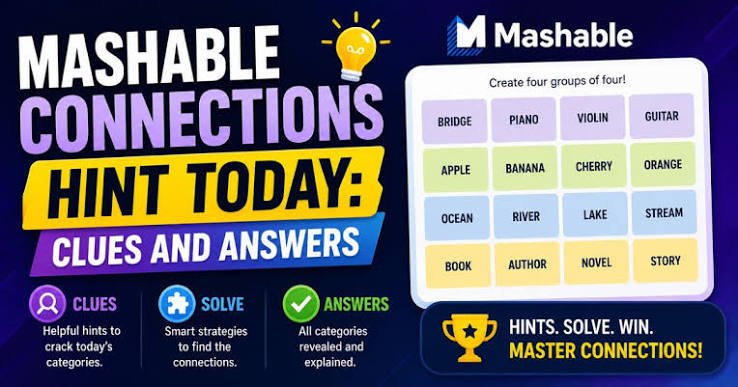

The Connections puzzle looks easy at first glance. You get 16 words. Your task is to divide them into four groups.
The challenge comes from the hidden relationships. Some words seem connected, but they belong elsewhere. That confusion makes the puzzle addictive.
Many players search for connections hints mashable when a grid becomes difficult. Hints can provide direction without immediately revealing everything. They can also help players understand how the puzzle works.
This guide explains the puzzle, common traps, useful strategies, and smarter ways to use hints.
What Are Connections Hints Mashable?
Connections hints are clues designed to help players solve difficult word groups.
Mashable has become associated with online coverage of popular games and daily puzzles. Players often search for guidance when they cannot identify the final category.
A good hint should preserve some of the challenge.
It should point toward an idea without giving away every word.
For example, a category might involve:
- Movie terms — Words linked to cinema.
- Food names — Items commonly found on menus.
- Verb forms — Words describing specific actions.
- Common phrases — Words completing familiar expressions.
The key is understanding the relationship.
The words themselves can be misleading. A single word may appear to fit several groups. That is where careful thinking becomes essential.
How the Connections Puzzle Works
The basic format uses 16 words.
Players must arrange them into four groups. Each group contains four related words.
| Puzzle Element | Meaning |
|---|---|
| 16 words | The complete starting grid |
| 4 groups | The final categories |
| 4 words | Required for each category |
| Limited mistakes | Incorrect guesses can endanger the game |
| Main objective | Discover all four relationships |
The categories can vary widely.
Some are obvious. Others require lateral thinking.
A group might depend on meaning. Another could depend on spelling. A third might use a phrase or cultural reference.
That variety creates the puzzle’s difficulty.
The strongest players do not simply look for similar words. They test whether four words share one precise connection.
How to Use Hints Without Spoiling the Puzzle
Hints work best when used gradually.
Checking the full solution immediately removes much of the challenge. A better approach is to use clues only when you become stuck.
Start With the Obvious
Scan all 16 words first.
Look for words that clearly belong together. Do not make a guess yet.
Ask yourself why those words connect.
Search for Four
Finding two related words is easy.
Finding four is harder.
A valid group normally needs a complete relationship. If you have only two words, keep investigating.
Consider Multiple Meanings
Many difficult puzzles use words with different meanings.
A word may describe an object. It may also appear in a phrase or represent an action.
This double meaning can create deliberate confusion.
Use Hints Later
If the grid remains unclear, use a hint.
Start with the least revealing clue available. Then return to the puzzle.
This keeps the solving process active.
Why Some Connections Groups Feel So Difficult
The puzzle designers can create difficulty in several ways.
One common method involves overlapping possibilities.
Imagine four words that seem related to sports. You might immediately assume they form a group.
Then you discover that one word belongs to another category.
That creates a trap.
Another challenge involves familiar phrases.
A word can look unrelated until it is paired with another word. Suddenly, the connection becomes obvious.
Some categories also rely on:
- Multiple meanings — One word has different uses.
- Wordplay — The connection depends on language.
- Names — People, places, or characters may form groups.
- Phrases — Words become related when combined.
- Categories — Items share a broader classification.
- Spelling patterns — The relationship may be visual.
The hardest categories often hide behind ordinary vocabulary.
Hints vs. Direct Answers: Which Is Better?
Both approaches serve different purposes.
| Method | Main Benefit | Main Weakness |
|---|---|---|
| Solve alone | Maximum satisfaction | Can take longer |
| Use a hint | Keeps the challenge alive | Gives away some direction |
| Check answers | Provides instant clarity | Removes the puzzle challenge |
| Study strategies | Improves future performance | Requires practice |
For regular players, hints usually offer the best balance.
They provide assistance without completely removing the discovery process.
Direct answers make more sense when you simply want to confirm a solution.
Strategies That Can Improve Your Connections Skills
Better solving comes from changing how you inspect the grid.
Look for Unusual Words
Start with words that seem oddly specific.
They may provide the strongest clue.
Common words can fit many categories. Unusual words often have fewer possibilities.
Test Complete Groups
Do not settle for a pair.
Try to find four words that share the same exact relationship.
If the fourth word feels forced, reconsider the group.
Watch for Red Herrings
A red herring is an attractive but incorrect connection.
Connections puzzles frequently use them.
A group may look perfect until one word creates a problem.
Think Beyond Definitions
Do not rely only on dictionary meanings.
Consider phrases, names, abbreviations, titles, objects, and cultural references.
The intended connection may sit outside the obvious definition.
Recheck Your Assumptions
If one group seems certain, test it again.
Ask whether another word could replace one member.
This simple habit can prevent many mistakes.
Why Players Search for Connections Hints Every Day
The daily format creates a strong routine.
Each puzzle offers a new set of words. The categories change. Yesterday’s successful strategy may not work today.
That unpredictability keeps the game interesting.
Players also enjoy sharing results with friends. Some compare solving times. Others compete over streaks.
Hints become useful when players want to continue playing without spending too long on one difficult grid.
For many people, the goal is not simply getting the answer.
It is recognizing the connection.
That moment of understanding provides much of the game’s appeal.
A Smarter Way to Approach a Difficult Grid
When you get stuck, stop guessing randomly.
Take a short reset.
Read every word again.
Then separate obvious relationships from uncertain ones.
Look for one strong category first. Once you identify it, remove those four words mentally.
The remaining 12 words become easier to analyze.
Repeat the process.
This method reduces visual clutter. It also prevents one confusing word from dominating your thinking.
If nothing works, use a hint.
Then return to the grid and finish the solve yourself.
Final Thoughts on Connections Hints Mashable
Searching for connections hints mashable can be useful when a daily puzzle becomes frustrating.
The best approach is controlled assistance.
Try solving independently first. Use category clues when necessary. Check the complete answers only when you are ready to stop solving.
Over time, studying these patterns can improve your puzzle skills.
The real advantage comes from learning how Connections thinks.
Once you recognize misleading words, hidden phrases, and overlapping categories, difficult grids become easier to break apart.
Disclaimer: This article is compiled from publicly available information and general puzzle knowledge. It is intended solely for educational and informational purposes and does not claim affiliation with or official endorsement by Mashable or the puzzle publisher.